
Newsletter Subscribe
Enter your email address below and subscribe to our newsletter
Enter your email address below and subscribe to our newsletter

 ByJohn A
For millions of Australians standing up from a sitting position has become a challenge, often requiring considerable thought and even preparation. Many have considerable pain on standing from sitting but are so restricted that they go for long periods of time and even travel long distances without standing up from a sitting position. While there are many solutions available to help Australians of reduced mobility to stand up these do not need to be complicated, expensive or invasive.
When we stand up from a seated position we require our quadriceps to contract and lift our entire body weight. Our knees, hips and ankles all work in unison and require great coordination to facilitate our movement. For people with arthritis, weak muscles, or balance problems simply standing up can be very difficult and even painful.
The problem of standing from a seated position is one of considerable duration for the millions of Australians who are experiencing difficulties with mobility. Initially there will be little change in people’s ability to stand from a seated position over a short period of time. However as time goes by the problem will persist and there will be an increase in the amount of time people spend sitting and a decrease in the amount of time people spend engaging in activity. This in turn will cause further decreases in muscle strength and joint stiffness. A fear of falling and/or pain on movement will also be experienced by many people and as a result will cause people to become more cautious and as a result less active. This in turn will cause a further decline in people’s ability to stand from a seated position.
The main cause of reduced mobility in older people is the degeneration of their joints. There are many different types of arthritis but the most common type that affects weight bearing joints of the body is osteoarthritis. The degeneration of the joint causes pain and makes movement such as standing up from sitting awkward and difficult. The degeneration of the joint also causes the joint to become stiffer making less range of motion for the joint.
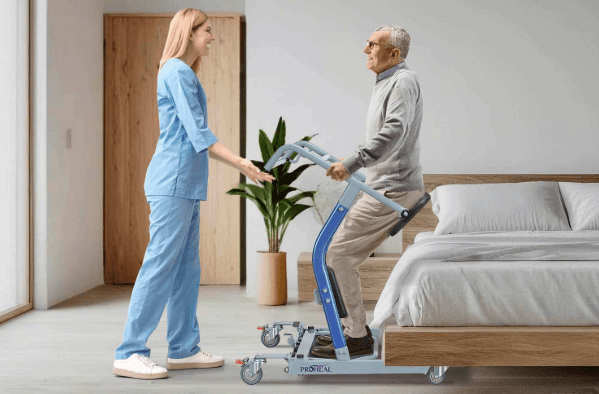
There are many different styles of lift assist chairs currently available on the market today. Lift chairs are simple, yet very effective mechanical devices that provide support for people to stand up from a seated position. Much of the muscle strength in our legs is used to stand up from a seated position. When we use a lift chair to stand up from a seat, the chair can take as much as 70-80% of the muscular strength out of lifting ones body up from a seated position and standing up. For people with very weak muscles, or for people who are in a lot of pain when they move, a lift chair can make a huge difference in their ability to perform daily tasks.
Lift assist technology is simple to use yet very effective. It uses a motor which lifts the seat of the chair forward and up slowly. The user is then slowly stood up by the chair, giving them much relief from having to rely on weak muscles to stand up. Essentially Lift Chairs enable people to stand up 70-80% less than if they were to stand up unassisted.
The angle of the lift is very important when sitting in a lift assist chair. When you first stand up from sitting in a chair you need to generate as much force as possible in your leg muscles to lift your body weight up off the seat. The greater the angle of the seat the more force you need to generate as the force of gravity trying to pull you back down to the floor is greater than the force of the seat trying to push you up into a standing position. In addition to this there is also the force of inertia which is also trying to keep you sitting back down in the chair. By tilting the seat forward the angle at which you sit is such that when you stand up the seat helps to position your center of gravity directly over your base of support, which in this case is your two feet on the floor. This enables you to balance while standing up from sitting in a chair.
An electric recliner chair for elderly people can enable them to stand up from a seated position with ease, and once they have mastered that action, they can go on to use the lift assist chair to freely move about. They can now go to answer the telephone, check on dinner, have a chat with friends and family or go out to social functions without fear of not being able to stand up from a seat.
Assistive Lift Chairs can also aid in Joint Preservation. By reducing strain on degenerating joints such as those affected by Osteoarthritis assistive lift chairs can slow down joint degeneration and help alleviate associated pain.
Movement needs to be controlled when getting up from a sitting position. When someone with arthritis stands up from a sitting position, large amounts of force go through the joints in the hips and knees. This can cause damage to the joints. Lift chairs for elderly people move slowly and are controlled in order to minimize stress on the joints.
On the downside of lift chairs for people with mobility problems there is a fear of users becoming to dependent on their chair. However when used correctly lift chairs can also help to maintain the function of a user’s muscles, enabling them to stand up from a sitting position and move around during the day, without feeling pain or tiredness. The more a person moves around during the day the more their muscles will be able to support their joints during mobility, thereby helping to preserve their mobility.
However the chairs do provide lift assist technology they are not designed to be a substitute for the physical activity that a person would normally do to stand up from a sitting position. These chairs actually allow people to stand up from a sitting position and to continue to stand up throughout the day without experiencing any fatigue or pain. They allow the muscles to be used as normal and as a result the user can continue to stand up as and when required.
See also: The Evolution of US Graduate Admissions: Navigating the New Era of Narrative-Driven Applications
The long term benefit of lift assist technology is that it allows for long term mobility, by allowing people to stand up and move around with ease. This means that they can continue to move around throughout the day, and participate in activities that they would otherwise avoid because of the pain of standing up from a sitting position.
The ability to carry out simple activities increases when standing up becomes pain free for people using lift assist technology. Users comment that they are able to stand up for lifts, for phone calls, for TV remote controls, for whatever is left on the floor and for walking around freely for the first time in years. All of these activities can increase health by increasing and improving circulation, bone density and the neural pathways controlling balance and co-ordination.
This means that as people’s mobility declines they are able to maintain the levels of activity they require for longer and as a result their overall health and wellbeing is maintained for longer too. And the good news is that it’s simple and very powerful and could add years of independent mobility to people’s lives.
